In several previous essays I’ve been trying to lay the foundations for what appears below: the outline of a system of taxation based on principles rather than mere political compromise alone. In future essays, I will elaborate on and defend the statements made here.
The Surplus Capacity Tax: Principle over Compromise
Under fiat currency, taxation’s economic function is not to fund government but to constrain aggregate consumption and thereby control inflation — the central insight of Abba Lerner’s Functional Finance framework. A tax should therefore be evaluated by its effect on consumption, not by revenue raised.
Equity requires that the burden of reduced consumption be distributed in proportion to each taxpayer’s ability to pay. The Benefit Principle and the Ability-to-Pay Principle, long treated as rivals, are in fact the same idea: each person’s economic position above the Hobbesian baseline — a normative reference point: the state of nature in which government does not exist and surplus accumulation is impossible — is simultaneously the measure of benefit received from the institutional order and the measure of ability to pay. Those who have achieved more within that order have benefited more from it, and bear a correspondingly greater obligation to sustain it.
Ability to pay, so understood, is measured by surplus consumption capacity — the fraction of income not required for consumption, as proxied by (1 − PC), where PC is the propensity to consume, whether measured as a marginal (MPC) or average (APC) rate. Because (1 − PC) rises with income, equal proportional sacrifice in consumption requires higher rates on higher incomes. A tax indexed to (1 − PC) appears progressive when measured against income, but it is strictly proportional when measured against what a monetary sovereign’s taxation actually constrains: consumption capacity. A tax designed on this principle is a Surplus Capacity Tax.
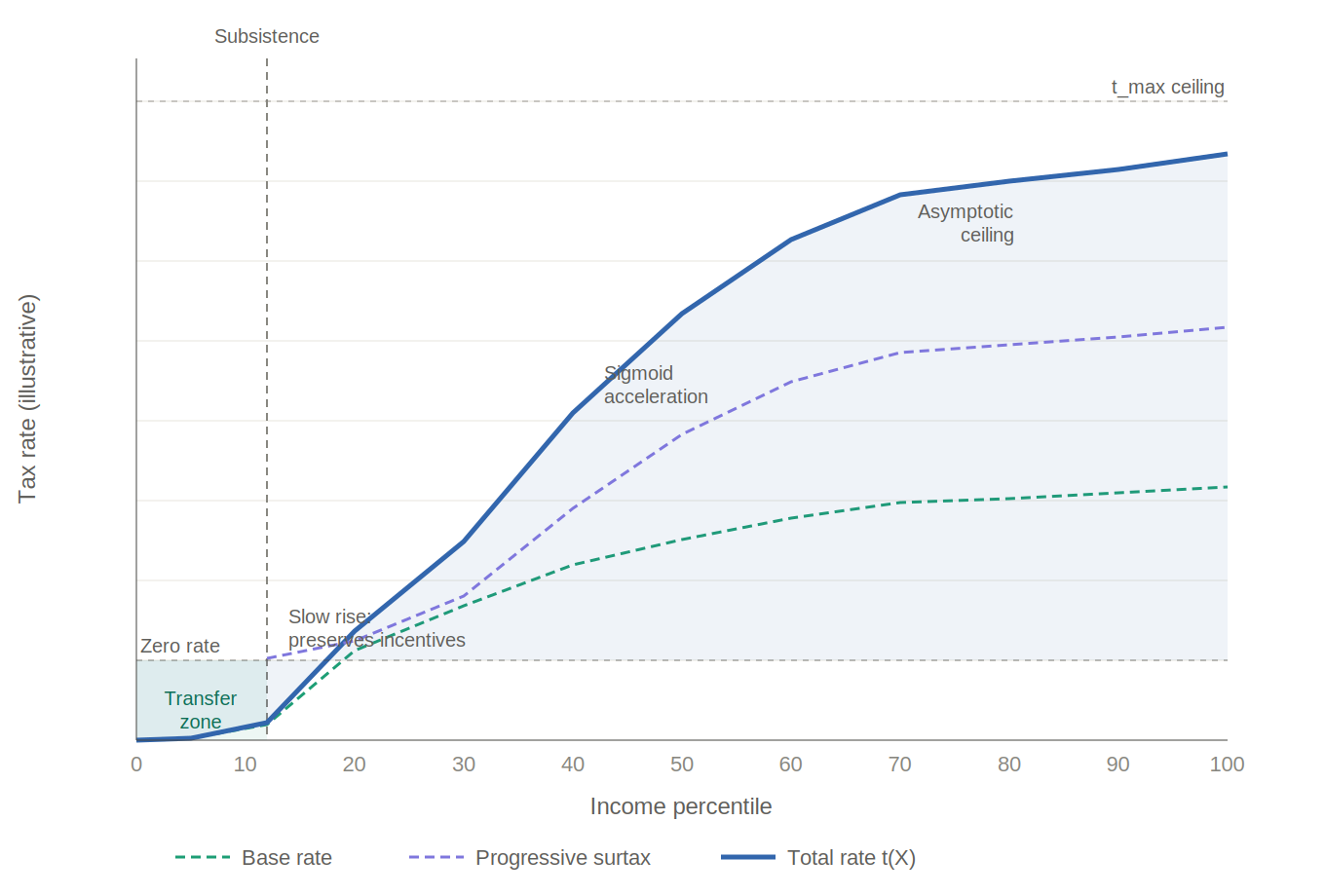
Taxation must not be ruinous. Every person is entitled to a subsistence exemption — a living-wage deduction sufficient for a minimal dignified life. Those whose incomes fall below subsistence should receive a negative tax (analogous to the EITC) rather than paying tax. No marginal rate should reach 100%, as that would eliminate the incentive to earn additional income. These constraints define the floor and ceiling of the Surplus Capacity Tax rate schedule.
Above the subsistence floor, the base Surplus Capacity Tax equalizes the sacrifice of consumption capacity across all taxpayers — not the sacrifice of income, but specifically the fraction of consumption capacity that taxation removes. Equity further supports a progressive surtax, reflecting the fact that wealthier individuals have derived greater benefit from the social and legal infrastructure — property rights, contract enforcement, stable currency, public investment — that makes the accumulation of surplus capacity possible in the first place. Those who have benefited more from that infrastructure bear a correspondingly greater obligation to sustain it.
This surtax should follow a sigmoid curve (an S-curve), which is the natural mathematical form satisfying three constraints simultaneously: it rises slowly at low and middle incomes, preserving the incentive to work and accumulate; it accelerates above a politically determined threshold, where surplus capacity is sufficiently large that equity demands a steeper contribution; and it approaches asymptotically a legislatively fixed maximum rate, ensuring that no marginal rate reaches the point of confiscation. The sigmoid is not an arbitrary choice — it is a natural and tractable class of curves that respects all three constraints at once, though the precise parameterization remains a matter of political determination.
For corporations, the same logic applies with one substitution. The normal competitive rate of return plays the role that subsistence income plays for individuals: it is the minimum return capital requires to remain in productive use, just as subsistence is the minimum income a person requires to remain a functioning member of society. Accordingly, returns below the normal rate should be exempt from the Surplus Capacity Tax. Above that threshold, the excess of investor returns over the normal rate measures corporate surplus capacity, and a sigmoid surtax rises from zero to a legislatively fixed maximum, following the same form as the individual surtax. The principle — tax surplus capacity, spare subsistence, preserve incentives — is the same in both individual and corporate cases.
The general form of the Surplus Capacity Tax rate schedule is:
t(X) = t_min + (t_max − t_min) · S(X)
where X is surplus capacity as defined for the taxpayer class, S(·) is a sigmoid function, t_min is the minimum rate, and t_max is the legislatively fixed ceiling. For individuals, X = (1 − PC(I)), where I is income above subsistence and PC(I) is the propensity to consume at income level I, whether measured as a marginal (MPC) or average (APC) rate; when PC > 1, X becomes negative and the formula delivers a transfer automatically, without special cases. For corporations, X = (R − R_n), where R is the actual rate of return and R_n is the normal competitive rate of return.
The result is a unified tax framework, governed by a single principle and a single mathematical form, applicable to both individuals and corporations under the name Surplus Capacity Tax. Its purpose is not to prescribe a perfect tax system but to establish an objective baseline — grounded in principle rather than political compromise — against which any actual tax system can be measured, its deviations identified, and its fairness debated.