

America’s loudest defenders of capitalism are systematically dismantling what makes capitalism capitalism. Meanwhile, its loudest critics accept a false definition and conclude the whole system must be overthrown. Both sides are wrong. This essay argues that the essence of capitalism, properly understood, is an institutional order enabling the generalized capacity of individuals to accumulate, retain, and deploy surplus—and that this capacity has never been fully realized. The systems Marx condemned as “capitalist” were institutionally incomplete, operating within states that lacked both the administrative capacity and the democratic mandate to fulfill capitalism’s promise. His pessimism was understandable: many of the necessary tools had not yet been imagined. The post-war democracies that invested most heavily in capitalism’s institutional infrastructure—progressive taxation, financial regulation, social insurance—produced the broadest shared prosperity in modern history, demonstrating that the promise is achievable. Yet much of that progress has since been reversed. Today, the political right undermines capitalism by dismantling its institutional prerequisites, while the political left undermines it by accepting a false definition that forecloses reform. The path forward is evolutionary institutional design, not revolutionary overthrow or institutional demolition.
What Capitalism Actually Is
Capitalism is not simply “markets.” Markets predate capitalism by millennia. Bazaars in ancient Mesopotamia, trading networks across the Roman Empire, merchant guilds in medieval Europe—none of these were capitalist in any meaningful sense. Capitalism is not simply “private property” either. Feudal lords held vast private estates. What, then, is distinctive about capitalism?
Standard definitions tend to assemble catalogs of observed attributes—markets, wage labor, private property, profit-seeking firms—but such catalog-like definitions produce analytical drift. Nearly all modern economies satisfy some subset of these attributes. No consensus exists on which are essential characteristics. The meaning of “capitalism” shifts with whoever is defining it, and disagreement reduces to taxonomic contestation rather than substantive inquiry. Worse, such definitions cannot distinguish capitalism from the feudal, mercantilist, and oligarchic systems that share many of the same surface attributes—which is precisely the distinction that matters.
A more precise definition, focused on the essence of capitalism’s institutional logic rather than the surface traits of systems called “capitalist”, restores analytical clarity:.
Capitalism is an institutional order characterized by the generalized legal and practical capacity of individuals to accumulate, retain, and deploy economically consequential surplus.
This definition isolates what is genuinely distinctive about capitalism. Each term does specific work. Generalized means the capacity is structurally available to all, not restricted by birth, caste, or sovereign favor to specific classes. Legal and practical means that formal rights without practical access are insufficient—the institutions must make accumulation genuinely possible, not merely nominally permitted. Accumulate captures the creation of surplus beyond subsistence. Retain captures the protection of that surplus from confiscation, inflation, or predatory extraction. And deploy captures the ability to put surplus to productive use—turning wealth into capital through investment, enterprise, or education.
Strictly speaking, “capital” means wealth deployed in production—a pile of gold hidden in a vault is wealth but not capital. The definition captures this distinction through “deploy”: capitalism enables not just the accumulation of providential personal financial buffers but also the productive investment of surplus. The capacity to save is the prerequisite for capital formation. You cannot invest what you do not have.
This is what distinguished capitalism from what came before. Under feudalism, serfs had customary use rights to land but could not sell, mortgage, or freely bequeath it. Guild systems restricted who could practice trades. Usury laws constrained credit. The legal and institutional framework was designed to freeze economic relationships, not enable mobility. Most people could not legally accumulate transferable wealth, let alone deploy it productively. Under mercantilism, the state directed economic activity for sovereign benefit. Economic opportunity depended on royal favor, monopoly charters, and guild membership. Accumulation capacity was structurally narrow. Under slavery, labor itself was someone else’s capital. The laborer had no legal right to the fruits of their own work—the most extreme denial of accumulation capacity imaginable.
Capitalism’s institutional revolution consisted of transferable property rights, open credit markets, legal personhood for commoners, and enforceable contracts between equals—the infrastructure that generalized the capacity to accumulate, retain, and deploy surplus. This was genuinely radical. For the first time in human history, the legal and institutional framework was being constructed to enable ordinary people—not just the wellborn, the politically connected, or the militarily powerful—to build wealth and put it to productive use.
No one articulated this promise more clearly than Abraham Lincoln. In his 1859 Address before the Wisconsin State Agricultural Society, Lincoln laid out the free labor vision in terms that map directly onto the definition above. He rejected the “mud sill” theory—the pro-slavery argument that laborers are permanently fixed in their condition, mere instruments of capital owners. Instead, Lincoln described the trajectory that capitalism’s institutions make possible:
The prudent, penniless beginner in the world, labors for wages awhile, saves a surplus with which to buy tools or land, for himself; then labors on his own account another while, and at length hires another new beginner to help him.
Lincoln called this “free labor—the just and generous, and prosperous system, which opens the way for all—gives hope to all, and energy, and progress, and improvement of condition to all.” At New Haven in 1860, he put it more directly: “I take it that it is best for all to leave each man free to acquire property as fast as he can. Some will get wealthy. I don’t believe in a law to prevent a man from getting rich; it would do more harm than good.” And, he wrote earlier: “There is no permanent class of hired laborers amongst us. Twenty-five years ago, I was a hired laborer. The hired laborer of yesterday, labors on his own account to-day; and will hire others to labor for him to-morrow. Advancement—improvement in condition—is the order of things in a society of equals.”
Lincoln also insisted that free labor required universal education—that “heads and hands should cooperate”—and that educated labor, applied to productive land, could make any community “independent of crowned kings, money kings, and land kings.”
Lincoln went further, expressing an aspiration: “If any continue through life in the condition of the hired laborer, it is not the fault of the system, but because of either a dependent nature which prefers it, or improvidence, folly, or singular misfortune.” This is best understood not as a description of the world Lincoln lived in—structural barriers were very real in 1859, and they remain so today—but as a statement of what capitalism should achieve. A world in which failure to flourish is genuinely attributable to individual choice rather than structural barriers would be a world in which capitalism’s institutional promise had been fully realized. We are far from that world. But Lincoln’s vision is the right one, and it demands, rather than excuses, the institutional infrastructure necessary to make it real. Those who invoke individual responsibility while dismantling the institutions that make individual agency possible are betraying Lincoln’s vision and thwarting capitalism, not fulfilling its promise.
Lincoln’s “prudent, penniless beginner” is a perfect illustration of the definition: a person with the generalized capacity to accumulate (save a surplus), retain (keep it securely), and deploy (buy tools or land)—and a system whose institutions make that trajectory available to all, not just the wellborn. Capital accumulation by ordinary people is the revolutionary promise of capitalism, and Lincoln articulated it as clearly as anyone.
Capitalism Requires Institutions—But Not Unlimited Government
The generalized accumulation capacity described above does not happen naturally. It requires institutional infrastructure. Property rights require enforcement through courts, registries, and police. Contracts require adjudication. Currency requires a sovereign guarantor. Competition requires antitrust enforcement—markets left alone tend toward monopoly, not competition. Broad-based capital accumulation requires education, transportation infrastructure, financial regulation, consumer protection, and labor standards. Karl Polanyi argued that market society was politically constructed and continuously sustained by state action; markets and states are interdependent, not opposing forces. And Dani Rodrik observed, “Capitalism is not self-creating, self-sustaining, self-regulating, or self-stabilizing.” The more effective the capitalism you want, the more sophisticated the institutions you need.
In a modern fiat-currency economy, taxation itself is part of the institutional infrastructure of capitalism. It is an essential tool for maintaining stable prices and managing aggregate demand—a vital public service without which the monetary system that enables both market transactions and the accumulation of wealth would collapse.
Price stability deserves special emphasis. Inflation is the silent destroyer of the capacity to accumulate. A worker who saves diligently for decades can have that surplus wiped out in a moment by monetary instability. Price stability—the protection of the retain function in our definition—is something that individuals absolutely cannot provide for themselves. Like roads and courts, it is a collective action problem requiring institutional coordination through central banking, fiscal policy, and taxation. No individual or private entity can substitute for these functions. Even the most ardent libertarian does not argue that individuals can independently control inflation. And yet without solving this collective problem, the entire project of individual savings and capital accumulation is undermined. The person who says “I don’t need government, I just want to save and invest” is depending on a government function for the very possibility of what they claim to do independently.
But this is not an argument for unlimited government. Lincoln understood both halves of the equation: both the necessarily broad scope of government as well as the proper limits on government. In 1854, he wrote:
The legitimate object of government, is to do for a community of people, whatever they need to have done, but can not do, at all, or can not, so well do, for themselves—in their separate, and individual capacities. In all that the people can individually do as well for themselves, government ought not to interfere.
Lincoln’s framework is precise. Government should do what individuals cannot do for themselves—and no more. But the scope of what individuals cannot do well for themselves is substantial. Lincoln enumerated: “public roads and highways, public schools, charities, pauperism, orphanages, estates of the deceased, and machinery of government itself.” And critically, Lincoln says “can not, so well do”—not “can not do at all.” Government should act not only when private action is impossible but when private action is inadequate. This is a much broader mandate than libertarians typically admit.
Even contract enforcement and the prevention of wrongs require collective institutional action. Lincoln’s quiet conclusion is devastating for the anti-institutionalists: “if all men were just, there still would be some, though not so much, need of government.” Even in a world of perfect virtue, institutions are needed—not just to prevent wickedness, but to coordinate collective action that individuals cannot accomplish alone.
Lincoln thus understood both the promise and the prerequisites of capitalism. The 1859 speech describes the goal: a system that “opens the way for all.” The 1854 fragment describes the means: government that does for the people what they cannot do well for themselves. The 1859 aspiration—that failure should be individual, not structural—describes the end state that adequate institutions should produce. Together they define a capitalism that requires robust institutions but resists overreach: government adequate to enable broad-based flourishing, restrained from doing what individuals can manage on their own.
The question was never whether government should exist, but whether it should serve all people or only the powerful. Every item on Lincoln’s list—roads, schools, contract enforcement, the machinery of government—is part of the institutional infrastructure of capitalism. Price stability belongs on that list too. To dismantle these things in capitalism’s name is to misunderstand what capitalism requires.
The Rise and Capture of Capitalism
When capitalism first emerged, it was genuinely radical—a liberation movement. It promised ordinary people a means to escape from feudal hierarchy, guild monopoly, and mercantilist favoritism. This is what Adam Smith celebrated: not the interests of merchants and manufacturers, whom he deeply distrusted, but the possibility that free competition could break the grip of entrenched privilege. Early capitalism delivered on parts of this promise—expanded mobility, new paths to independence, erosion of hereditary economic caste.
But capitalism emerged within feudal and mercantilist societies. It did not replace them cleanly. Feudal power structures, aristocratic privilege, guild monopolies, colonial extraction—these were never fully dismantled. The new institutional logic of capitalism—open markets, transferable property, broad-based accumulation—was layered on top of old power structures, and the old power interests adapted, co-opted, and reshaped the new institutions to serve incumbents.
Some of the new institutional mechanisms—particularly those enabling concentrated industrial wealth—actually reinforced the old hierarchical patterns. The factory owner, running a company town, became the new lord of the manor, with the same practical power over workers’ lives that the feudal lord had once exercised, but without the feudal lord’s customary obligations to his vassals. Where once guilds had enabled tradesmen to organize, the new institutions enabled the suppression of labor unions and thus greatly empowered the elites. By Marx’s time, the system operating under the name “capitalism” had never fully de-feudalized—and had, in important ways, given new force to the very hierarchies that real capitalism would have dismantled. The institutional revolution was in-progress, but incomplete—and the state lacked both the administrative capacity and the democratic mandate to complete it. There was no central banking, no securities regulation, no antitrust law, no income tax. The franchise was restricted to property owners. The very people who most needed capitalism’s institutions had no political voice with which to demand them. New mechanisms of wealth creation were grafted onto old structures of power and privilege, and the old interests—well-represented in the parliaments that excluded workers—proved adept at capturing the new mechanisms for their own essentially anti-capitalist purposes.
Marx brilliantly diagnosed the gap between capitalism’s promises and the reality of those systems called “capitalist”—but drew the wrong conclusion about why the gap existed. He saw a system that promised generalized accumulation but instead delivered concentrated wealth, and he concluded that the concentration was inherent to the system’s logic. His pessimism about reform was understandable: the institutional tools that might have made capitalism’s promise real—central banking, securities regulation, antitrust law, progressive income taxation—barely existed in his time, and some had not yet been imagined. The state that would have wielded such tools was structurally captured by the very interests that benefited from the status quo. The alternative explanation—that the institutions necessary to fulfill capitalism’s promise had never been fully constructed yet could be constructed given sufficient state capacity and democratic accountability—was not so much rejected by Marx as rendered invisible by the world he inhabited.
This misunderstanding has shaped political discourse ever since. Defenders of capitalism celebrate a system that does not fully exist. Critics attack “capitalism” when what they are really describing is capitalism’s capture. The anti-capitalist counter-revolution never announced itself—it called itself capitalism, just as today’s institutional demolitionists call themselves capitalism’s defenders.
The Right’s Error: “Pro-Capitalist” Policies That Undermine Capitalism
Consider the policies most commonly defended in capitalism’s name. Slashing public education reduces human capital formation for ordinary people. Deregulating finance enables predatory extraction rather than productive investment. Weakening antitrust allows monopoly rents that suppress competition. Cutting infrastructure investment reduces the physical substrate of commerce. Opposing labor standards pushes workers below the threshold where capital accumulation is possible. Tax structures that concentrate wealth reverse the broad-based accumulation that defines capitalism. Each of these policies, defended in capitalism’s name, actually moves the economy away from capitalism and toward something older and less democratic.
The deeper problem is that excess income and wealth do not just represent an inequality concern—they actively reduce the state’s capacity to regulate the economic system and preserve capitalism itself. Concentrated wealth captures regulatory institutions, shapes law to protect incumbents, and undermines the very institutional infrastructure that capitalism requires. The concentration of wealth is thus self-reinforcing and self-accelerating unless checked by institutions.
The United Kingdom illustrates this dynamic clearly. The Thatcher reforms of the 1980s, such as the selling of Council Housing to its tenants at a discount, moved the economy toward greater private ownership—but did not broaden accumulation capacity. Quite the opposite: privatization was accompanied by a compression of accumulation breadth that has continued in subsequent decades. Ownership shifted from public to private hands, but the generalized capacity to accumulate, retain, and deploy surplus narrowed rather than widened. The rich got richer, the poor did not. This pattern was repeated in the privatization of Soviet state assets in the 1990s. Although proclaimed as a move to broaden asset ownership, it resulted in a reconcentration of assets in the hands of oligarchs. Privatization does not mechanically imply broadened accumulation. Moving assets from public to private ownership benefits capitalism only if the institutional framework ensures that private ownership is and remains broadly accessible. Otherwise, it merely concentrates existing wealth.
The contrast with the post-war period is instructive. From 1945 to the mid-1970s, the democracies that invested most heavily in capitalism’s institutional infrastructure—progressive taxation, financial regulation, strong labor standards, social insurance, public education—produced the broadest period of shared prosperity in modern history. The Nordic countries have continued to demonstrate this pattern: robust institutional frameworks that produce, rather than impede, broad-based accumulation. If this resembles what is sometimes called social democracy, that is not an objection—it is evidence that social democracies have been, in practice, closer to real capitalism than the systems that more loudly claim the name.
But much of the post-war progress has since been systematically dismantled. Beginning in the late 1970s, the neoliberal turn—deregulation, tax cuts for the wealthy, weakening of unions, erosion of public investment—reversed the broadening of accumulation capacity and reconcentrated wealth, repeating the pattern of Marx’s era: incumbent elites capturing the institutional framework and reshaping it to serve their own interests, all while claiming to defend or strengthen capitalism.
It is often said that “conservatives” are those who seek to preserve and strengthen institutions. They would seem to be the natural defenders of capitalism, since capitalism requires stable and strong institutions. Yet today’s self-described conservatives are leading the charge to dismantle institutions. Lincoln’s own framework condemns this: public roads, public schools, contract enforcement, the machinery of government—these are things people “can not, so well do, for themselves.” Dismantling them is not limiting government to its legitimate object; it is preventing government from fulfilling it.
If Not Capitalism, Then What? A Conceptual Map
To clarify what happens when capitalism’s institutions decay, it helps to distinguish between two fundamental dimensions of any economic system:
Ownership of Productive Assets: Are the primary means of production (factories, land, infrastructure) held privately or collectively by the state or community?
Breadth of Accumulation Capacity: Is the ability to accumulate, retain, and deploy surplus generalized across the population, or is it restricted to a narrow elite?
As this essay argues, the first dimension distinguishes private-property systems from socialist ones, while the second dimension distinguishes real capitalism from its imposters. By plotting these two independent axes, we can create a conceptual map of different economic regimes (see Figure 1).
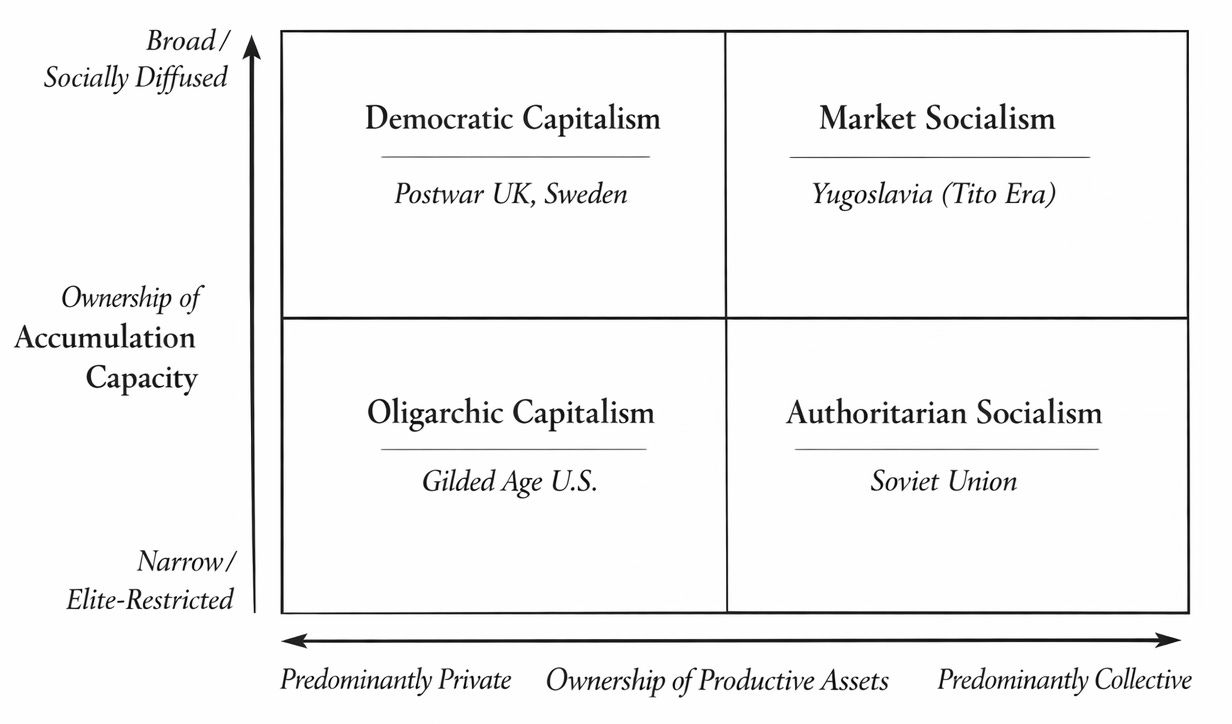
This framework reveals that stripping away the institutions that enable broad-based accumulation does not produce “freer” capitalism. Instead, it pushes a society down the vertical axis, from the top-left quadrant (Democratic Capitalism) to the bottom-left (Oligarchic “Capitalism”). This bottom-left quadrant is home to a variety of non-capitalist systems that often claim the capitalist label while violating its core institutional logic:
Neofeudalism: When hereditary wealth transmission is unchecked, dynastic control of resources hardens, and economic caste becomes self-perpetuating. Wealth and power are determined by birth, with the tech billionaire or the heir to an industrial fortune serving as the new lord of the manor. This is a system of private ownership but narrow, elite-restricted accumulation.
Crony Capitalism / Corporatism: When regulatory capture allows incumbent firms to write the rules, suppress competition, and extract rents through political connection. The forms of capitalism are preserved, but accumulation capacity is restricted to the politically connected, not generalized.
Fascism: When concentrated private wealth merges with state power in a nationalist framework, suppressing labor organization and independent institutions while maintaining the facade of private enterprise. It destroys capitalism’s institutional prerequisites for broad accumulation, concentrating power and wealth in a symbiotic elite of state and corporate actors.
All of these systems feature private ownership of productive assets, which leads both their defenders and their critics to mislabel them as “capitalism.” But in each case, the generalized capacity for accumulation has been extinguished in favor of elite-restricted access. They are not capitalism as properly understood. The quadrant helps clarify why: they occupy a different institutional space. The debate we should be having is not just about moving left or right on the ownership axis, but about how to build and maintain the institutions that keep us in the top-left quadrant, realizing the promise of a truly democratic and inclusive capitalism.
The Left’s Error: Accepting the False Definition
Critics who accept that capitalism is exploitation, inequality, and environmental destruction make the mirror-image mistake. By treating these as inherent, definitional features of capitalism—as if they were laws of nature—they foreclose the possibility of reform and progress.
If capitalism necessarily produces these outcomes, the only option is revolutionary overthrow—historically the most costly, dangerous, and unreliable path to social improvement. But if these outcomes result from inadequate institutional development—capitalism without sufficient capitalist institutions—then the better path forward is evolutionary: build better institutions. Evolution is almost always more achievable, less destructive, and more durable than attempted revolution.
The irony is that by accepting the libertarian’s definition of capitalism—unregulated markets, minimal state—the left unwittingly strengthens the case for radicalism over reform. When you tell people the system is inherently rotten, you do not inspire institutional improvement. You inspire either despair or a desire for destructive upheaval.
The left is self-defeating in another way. Its focus on outcomes over institutions means it neglects the very institutional infrastructure needed to produce the outcomes it seeks. If the left learned to love capitalism—properly understood—it could more easily achieve its goals through institutional evolution than through the revolutionary transformation it sometimes dreams of.
Both errors—the right’s and the left’s—serve the interests of those who benefit from the current dysfunctional arrangements.
There Is No Inherent Conflict Between Capitalism and the Social Safety Net
Many programs commonly described as “socialist” are, in fact, neither socialist nor anti-capitalist. This confusion rests on a category error. Capitalism and socialism are not opposite ends of a single axis—they concern different dimensions of institutional design. Capitalism concerns the breadth of accumulation capacity: how widely is the ability to accumulate, retain, and deploy surplus distributed? Socialism concerns ownership structure: are productive assets held privately or collectively? These are analytically independent questions. A society can have broad accumulation capacity and collective risk-sharing simultaneously. Labeling social insurance “socialist” is a category error, not a political analysis.
Social Security, unemployment insurance, public health insurance, public education—none of these restrict individuals’ ability to accumulate capital. They do not collectivize ownership of productive assets. In fact, they enhance accumulation capacity. A worker who is not one illness away from bankruptcy is a worker who can save, invest, and take productive risks. Social safety net programs provide the floor of security from which broad-based capital accumulation becomes possible.
Lincoln’s “prudent, penniless beginner” needed tools and land. Today’s beginner needs different, but analogous, prerequisites. The modern equivalent of “tools and land” is not just physical capital, but human and financial capital: education without crushing debt, healthcare that doesn’t lead to bankruptcy, and access to a stable financial system for savings and credit. The institutional charge remains the same, even if the specific policies required to meet it have evolved.
The Shared Mistake and Why It Persists
Both sides accept the same false equation: capitalism equals whatever economic arrangements currently exist, or existed during industrialization. This is why the debate is so sterile and so frustrating. The right says “capitalism means unregulated markets, and that’s good.” The left says “capitalism means exploitation, and that’s bad.” Both accept the same definition. Both are wrong.
The confusion has deep historical roots. Capitalism and laissez-faire rhetoric emerged together in opposition to mercantilism, and Smith’s critique of mercantilist state intervention has been persistently misread as a critique of all institutional structure. The Cold War hardened this into a binary—capitalism equals less government, socialism equals more government—that obscures rather than illuminates.
Those who benefit from concentrated wealth have obvious incentive to maintain the confusion. If “capitalism” is just a floating signifier attached to whatever economic system currently exists, then defending capitalism means defending the position of those who it has benefited most—whether or not that system benefits others. Meanwhile, critics of the status quo have their own strong incentive to accept the false definition. If capitalism is the problem, the solution is dramatic and morally clear—which is more satisfying than the patient, incremental work of institutional reform.
The ultimate test of any economic system is whether it serves the flourishing of the individuals who live within it. Government is made to serve people, not people to serve government. Capitalism, properly understood, takes individual flourishing as its direct aim—the collective benefit emerges from millions of people successfully building the capacity to lead independent lives. Systems that reverse this priority—subordinating individuals to an abstracted common good or to a powerful elite—historically produce neither the common good nor the individual flourishing they promise.
But “properly understood” is doing essential work in that last paragraph. Individual flourishing does not emerge from unregulated self-interest any more than a garden emerges from untended soil. It requires the institutional infrastructure—education, law, regulation, public investment—that enables self-interest to become productive rather than predatory. The collective benefit is real, but it is a product of institutional design, not of serendipity. Adam Smith’s insight that private interest can serve public benefit was always conditional—dependent on the institutional framework within which that self-interest operates. Those who cite Smith’s “invisible hand” in defense of unregulated markets are making the same error as those who cite Marx in defense of revolutionary overthrow. They extract a conditional claim from its context and treat it as unconditional.
The Debate We Should Have: Institutional Design
Once we clear away the definitional confusion, the productive question emerges: which institutional arrangements best fulfill capitalism’s promise—the generalized capacity to accumulate, retain, and deploy surplus?
The practical path forward is to use markets for what they do well—distributed coordination, incentive alignment, innovation—while building institutions to correct what they do poorly: distributional justice, externalities, public goods, preventing concentration. This is capitalism—real capitalism—not a compromise between capitalism and something else.
Every institutional system requires ongoing maintenance. The gap between principle and practice is permanent and universal—no system has ever fully realized its own ideals, and none ever will. The relevant question is not whether the gap exists—it always does—but whether the principles are worth the cost of their maintenance. We do not abandon democracy because every democracy has corruption. We do not abandon medicine because every doctor sometimes makes errors. We recognize that complex institutional achievements require continuous effort, vigilance, and reform. The same is true of capitalism.
A government committed to capitalism should feel obligated to ensure that all of its citizens can accumulate savings and flourish without undue dependence on either state or patron. The goal is not to eliminate super-normal returns and inequality of outcomes entirely—some are not only inevitable but desirable, since they motivate productivity and innovation. But there is a point at which returns are so excessive that they no longer serve a societal purpose—when they cease to incentivize and begin merely to concentrate.
The precise point at which returns cease to incentivize and begin merely to concentrate is a legitimate and important question, one that requires its own careful analysis. But the difficulty of drawing a precise line does not negate the existence of the problem. We do not refuse to treat fever because body temperature exists on a continuum. We recognize that while 99°F is a minor variance, 105°F indicates a life-threatening crisis requiring immediate intervention. The fact that we cannot specify an exact dollar threshold does not mean we cannot recognize when accumulation has clearly exceeded any incentive function and has begun to distort the institutional framework itself.
Beyond the inequality concern, excess wealth actively undermines the state’s capacity to regulate the economic system and preserve capitalism itself. Concentrated wealth captures institutions, shapes law, and erodes the very infrastructure that broad-based accumulation requires. This is how capitalism is destroyed from within: not by its critics, but by its supposed beneficiaries whose excess destabilizes the institutions that made their accumulation possible.
Institutions should progressively resist further excess—not by confiscating private property, but by calibrating the system to discourage returns beyond their useful social function. A need to resort to confiscation would itself indicate a failure of government and society to preserve capitalism by other, less drastic means. It may sometimes be necessary, but only as a last resort—evidence that earlier institutional safeguards failed.
We have the institutional tools to address excess: progressive taxation, antitrust enforcement, financial regulation, public investment. We should use them and see if they provide a sufficient solution to the problems that have long been identified before concluding that more radical measures are needed.
The question is not “how much government?” but “which institutions, designed how, serving whom?” Or, in Lincoln’s terms: what are the things that people “can not, so well do, for themselves”—and are we doing them?
Closing
Those who genuinely believe in capitalism’s promise—that ordinary people can and should be able to build lives of independence through their own productive effort—should be capitalism’s most vigorous institutional defenders. And those who rightly identify the excesses of our current system should recognize that reform intended to better achieve real capitalism, not revolution, is both the more practical and the more radical path. Evolution is almost always more achievable, less destructive, and more durable than revolution.
Capitalism requires institutions that open the way forward for all. Government’s legitimate object is to do for people what they cannot do well for themselves—and the infrastructure of a just, capitalist economy is precisely such a thing. To defend capitalism is to defend the institutions that make it real.
What would institutionally serious “real capitalism” look like? Future essays will explore the principles that should guide institutional design—including how tax systems can serve, rather than undermine, capitalism’s core commitment to broad-based flourishing.
A few things. One big difference between the 45-75 time period in the US and the present as well as the present US vs. the Nordic countries is the prevalence of labor unions. The decline of private sector unions in the US has been enormous and has affected both the economy and politics - it has led to the decline of defined benefit pensions as well as comprehensive health care coverage and job security. I am not sure whether one might conclude that strong private sector unions may be a necessary component of a healthy capitalist system - that sounds wrong but maybe it is right.
Secondly, free market capitalism is messy. There are entrepreneurs who are negative savers but get money from wealthy investors or friends and family or ELOCs and go on to build very successful businesses without ever having "saved" a dime. Networks of savers, investors, speculators, etc. are very important. Leverage is heavily used in the early stages of many businesses. There are businesses with negative balance sheets which turn out to be successful. Just as not every country can run a trade surplus; so too every household cannot be a net saver. And the data is messy - the second quintile includes single individuals living in low living cost areas who are perfectly capable of saving part of their income as well as families of 7 living in San Francisco on public assistance.
Neoliberalism is the ideology everyone suddenly loves to hate but it 1. gave us low tariffs and free trade which are starting to look pretty good, 2. eliminated feudal type self regulation in the trucking industry which created ridiculous inefficiencies due to gateways and back haul restrictions, empowered a corrupt union, and wasted enormous amounts of fossil fuels, 3. rescued the railroads from a deepening cycle of bankruptcies and abandonments, 4. opened up air travel to the lower middle class, 5. simplified the tax code, 6. opened telecommunications to competition, 7. led to a wave of innovation and economic growth, and 8. eliminated a regime of absurd oil and gas price control which led to overconsumption and dependence on imports from questionable sources.